Budgeting for Clay Liners: What Drives the Cost 

How much does a GCL cost per square metre?” is one of the most common questions we get, and it’s also one of the hardest to answer honestly in a single number. Two projects asking for what sounds like the same product can end up with quotes that differ by a wide margin. The reason usually isn’t that one supplier is overcharging. It’s that “GCL” covers a range of constructions with genuinely different specifications, each priced accordingly.

If you’re budgeting a project that includes a geosynthetic clay liner, the useful exercise isn’t finding the lowest per-roll rate. It’s understanding which variables actually move the price, so you can compare quotes on equal terms. That matters most on tender-driven projects, where the lowest quoted rate can win the line item even when it’s built on a thinner spec than the application actually needs. Here’s what drives GCL costs and where the real savings and the real risks tend to hide.

What a GCL Actually Is, Briefly

A geosynthetic clay liner is a manufactured composite: a layer of sodium bentonite clay sandwiched between geotextile layers, usually mechanically bonded for shear strength. Ennkae’s nKlay combines natural sodium bentonite with durable geotextiles to form a low-permeability barrier, positioned as a faster, more consistent alternative to a traditional compacted clay liner.

The bentonite is the working part of the system. It swells dramatically when it absorbs moisture, forming a low-permeability barrier, and it keeps a self-sealing property even after installation. If the layer above is ever punctured, bentonite at that point swells into the gap and reseals it, something a compacted clay liner or a standalone geomembrane can’t do on its own. That self-sealing characteristic is a big part of why GCL commands the price it does.

The Numbers That Actually Move the Price

nKlay’s published specifications give a useful reference point for what you should be asking any supplier for. Thickness runs 6 to 13 mm. Tensile strength is rated at 8 MPa, peel strength at 14 MPa, and puncture resistance at 2 kN. Swell index sits at 25 mL per 2 g of bentonite, a standard measure of how much the clay expands on contact with water, which is directly tied to how well the liner seals itself. Roll sizes run 5.15 by 40 metres as standard, with custom sizes available for specific projects.

Construction type is a major variable across the market. Needle-punched GCLs, where fibres are mechanically driven through all three layers to lock the bentonite in place, generally offer higher internal shear strength. That matters in sloped applications, where a weak internal bond can let the liner slip along its own bentonite layer under gravity. Adhesive-bonded constructions can be more economical for flat, low-slope applications where shear strength matters less.

The carrier geotextile also affects price. A GCL might use a woven fabric on one or both faces, a non-woven, or a combination, and the weight and quality of that carrier factor into overall cost, much the same way the non-woven geotextile used elsewhere on a site is priced according to its own specification.

Letting the Project Type Set the Spec

It’s tempting to work backwards from a target budget to a liner spec, but that ordering tends to produce liners that are under-specified for what they’re actually containing. A better starting point is the application itself.

A farm pond or agricultural water storage project, where minor seepage is an inconvenience rather than an environmental risk, can often be specified toward a lighter, more economical build without meaningfully compromising performance. A landfill cell, an effluent lagoon, or any application with a regulatory compliance requirement attached is a different conversation. Ennkae’s nKlay is used across landfill liners and caps, pond and canal linings, mining and heap leach pads, secondary containment around fuel and chemical tanks, and tunnel and underground waterproofing, and the specification needed for a landfill cap is not the specification needed for a decorative pond.

Getting a clear answer on which category your project falls into, before requesting quotes, makes it much easier to tell whether a low quote reflects genuine efficiency or a spec that’s been quietly thinned out to hit a price point.

Roll Size, Overlaps, and the Hidden Material Cost

The quoted price per roll rarely tells the whole story, because installed area and purchased area aren’t the same number. Every seam between adjacent rolls needs an overlap, and Ennkae’s installation guidance calls for roughly 300 mm, optionally sealed with bentonite powder or a polyurethane sealant for extra assurance. That overlap is bentonite you’re paying for twice, once on each side of the seam.

On a large project with a lot of linear seams, that overlap adds up to a meaningful share of total material cost. Wider rolls that reduce the total number of seams can end up cheaper in total installed cost even at a similar price per roll. It’s worth asking suppliers about this directly, since it rarely shows up clearly on a basic quote. Anchor trenches at the top of slopes and around the perimeter of a lined area also consume material beyond the flat installed area, and should be accounted for in the takeoff rather than discovered as a budget overrun once installation is already underway.

Material Cost vs Installed Cost

A quote for material alone, rolls delivered to site, is a different number from a turnkey, supply-and-install price. Comparing a material-only quote from one supplier against an installed price from another is one of the more common ways budgets go wrong early in a project.

Installation quality matters enormously for a GCL specifically, because seams and anchor details are where failures concentrate if the work is rushed or done by a crew unfamiliar with the material. A slightly higher installed price from a supplier who can demonstrate proper installation experience, correct overlap, proper hydration sequencing, and adequate anchoring is very often better value than the lowest material-only quote, once you factor in the cost of fixing a poorly installed liner afterward. For projects weighing a GCL against an HDPE geomembrane, or a composite of the two, get installed pricing for both before deciding. Our guide on choosing the right liner for water storage and waterproofing covers the geomembrane side of that comparison, including where the two materials are increasingly specified together rather than as competing alternatives.

Where GCL Actually Saves Money

Compared to a traditional compacted clay liner, thick sections of carefully sourced and compacted natural clay, a GCL’s material cost per square metre often looks higher at first glance. But the comparison rarely stops at material cost. A compacted clay liner needs a much greater volume of imported, tested clay and weeks of controlled compaction work to reach the same performance a few millimetres of GCL delivers in a fraction of the time. That shows up as reduced excavation, reduced haulage, and a shorter construction schedule, real costs that a per-square-metre comparison misses entirely.

Over the operating life of the structure, the self-sealing bentonite core also tends to reduce long-term maintenance and repair costs compared to a compacted clay layer, which can crack if it ever dries out and has no equivalent way to repair itself. Weighed as total project cost, material, installation, schedule, and expected maintenance, GCL usually looks like the more economical option rather than the more expensive one.

What to Ask For When Getting a Quote

A few specific requests turn a vague quote into one you can actually compare. Ask for thickness and confirm it sits in a realistic range for your application, typically 6 mm and up for most containment work. Ask whether the construction is needle-punched or adhesive-bonded, and whether that matches your slope and shear strength requirements. Request test data for tensile strength, peel strength, puncture resistance, and swell index, along with the standard each test was run against, so you’re comparing certified performance rather than a marketing claim.

It’s also worth asking directly for the recommended overlap and anchor trench allowance, since that’s the detail most likely to turn an attractive per-roll price into a higher total material order once the actual installed area is calculated.

Conclusion

GCL pricing genuinely does vary for good reasons: thickness, construction method, carrier fabric, and installation quality all move the number, and the lowest quote on paper isn’t always the lowest cost by the time the project is complete. A budget built around real specifications, overlap allowance, and installed cost, rather than a bare roll price, is far less likely to run into surprises partway through the project.

If you’re pricing a containment or lining project and want a GCL specification and cost estimate matched to your actual site conditions, reach out to our team with the project scale and application. That’s usually enough to put together an accurate, comparable quote.
Geocell vs Geogrid: Which Ground Stabilizer Wins? 

Ask two different engineers to explain the difference between geocell and geogrid, and you’ll often get two different answers. Not because either is wrong, but because the two materials genuinely get used interchangeably in casual conversation, despite doing structurally different jobs. Both are polymer-based ground reinforcement products. Both show up in tender documents for roads, slopes, and retaining structures. And both get lumped together under the vague heading of “ground stabilisation” often enough that the real distinction gets lost.

It matters, though. Specifying the wrong one doesn’t just mean overpaying. It can mean a slope face that a geogrid was never designed to hold, or a pavement base reinforced with a product built for vertical confinement instead of horizontal load spread. Here’s the difference that actually matters, and how to decide which one your project needs.

Two Different Shapes, Two Different Jobs

The clearest way to understand the difference is geometric. A geocell is a three-dimensional honeycomb structure: strips of polymer welded together at intervals and expanded on site into a network of open cells, then filled with soil, aggregate, or sometimes concrete. A geogrid is a two-dimensional planar grid, a flat sheet of connected polymer ribs with regular openings, laid horizontally within a soil or pavement structure.

That geometric difference drives everything else. A geocell’s cell walls physically surround the infill material on every side, restraining it from moving laterally in any direction. That’s exactly what you want on a slope face or a channel bed, where gravity is constantly pulling material downward and outward. A geogrid works through a different mechanism entirely. Soil particles interlock with the grid’s openings as load passes through, spreading that load across a wider area and adding tensile strength to a layer that would otherwise only resist compression. It’s reinforcement, not confinement, and that distinction explains why substituting one for the other often doesn’t just underperform. It can miss the structural function entirely.

How GeoCell Confinement Works

Picture a steep slope face, a channel bed, or a retaining structure where the design problem is keeping material from sliding or washing away under gravity and water flow. This is geocell territory. Ennkae Cell, our GeoCell system, is manufactured from HDPE and welded at the junctions to form the honeycomb structure. Once expanded and staked into position, the cells are filled: with topsoil and seeded for a vegetated finish, with aggregate for a load-bearing surface, or with concrete for a hard-armoured channel lining.

The cell walls hold that infill exactly where it was placed, cell by cell, regardless of the slope angle beneath it. Ennkae’s range is available in cell depths of 75, 100, 125, 150, 200, 250, and 300 mm, which lets the confinement depth be matched to the actual load and slope conditions rather than defaulting to a single size. This makes geocell particularly effective on applications a flat reinforcement layer can’t handle: steep cut and fill slopes, channel and spillway linings, retaining wall faces, and load support over soft ground, where the 3D confinement spreads load across a much larger effective area than the same aggregate would achieve unconfined.

It’s also specified for the kind of disaster-tolerant infrastructure that’s become a bigger priority on Indian highway and rail projects in recent years: slopes and embankments that need to survive extreme rainfall events without catastrophic failure. Because each cell acts as its own small containment unit, localised damage to one section doesn’t cascade into a broader slope failure. A punctured cell wall or a washed-out patch stays contained to that spot, rather than triggering a chain reaction across the whole face.

How Geogrid Reinforcement Works

Geogrid solves a different problem: adding tensile strength to a horizontal layer that otherwise has none. Soil and aggregate are strong in compression but weak in tension, which shows up as rutting, cracking, and differential settlement in pavements and embankments over time. A geogrid laid within the base course or embankment fill interlocks with the surrounding material and carries tensile stress the soil alone can’t, spreading load more evenly and reducing the deformation that would otherwise concentrate under repeated traffic.

This is why geogrid shows up so often in pavement base reinforcement, in mechanically stabilised earth walls, where alternating layers of geogrid and compacted fill build a reinforced soil mass strong enough to act as a retaining structure without a conventional concrete wall, and in embankments built over soft ground, where basal reinforcement helps bridge weak spots and reduce settlement.

When Slope Geometry Decides the Answer

In practice, the choice often comes down to a simple question: is the problem primarily vertical or primarily horizontal? Steep slope faces, channel linings, retaining structures, and anywhere confinement needs to act against gravity pulling material outward point toward geocell. Its three-dimensional structure is built for exactly that kind of restraint. Pavement layers, embankment fill over soft ground, and large flat reinforcement zones point toward geogrid instead, since the goal there is spreading load and adding tensile capacity within a horizontal plane.

Some projects need both, applied to the specific zones where each actually does its job. A common composite approach uses geogrid as basal reinforcement across a soft foundation layer, with a geocell system built above it to confine the slope face or channel section sitting on top. The geogrid handles the horizontal load-spreading problem at depth. The geocell handles the vertical confinement problem at the surface. Neither product is trying to do the other’s job.

What to Check Before Choosing a Supplier

Once geocell is confirmed as the right technology, the next decision, which manufacturer to buy from, matters almost as much as the product category itself. Weld strength between the polymer strips is the first thing worth verifying. A geocell is only as strong as the seams joining individual cells together. Ennkae publishes seam peel strength by cell depth, tested to the US Army Corps of Engineers technical report GL-86-19: 1065 N at 75 mm depth, rising to 4260 N at 300 mm depth. Ask any supplier for this kind of test data rather than a general material data sheet.

Perforation pattern is worth checking too, especially for vegetated or drainage-adjacent applications. Ennkae’s cell walls are perforated with horizontal rows of holes, up to 10 mm in diameter, covering less than 12% of the cell surface, which allows lateral root growth and water movement between cells. UV and weathering resistance matter for any polymer product exposed to sunlight during and after installation. Ennkae’s material carries an environmental stress crack resistance rating of over 5000 hours under ASTM D 1693, a standard measure of how well the polymer holds up over time without becoming brittle.

Why We Build Around GeoCell

It’s worth being straightforward here. Our product range is built around GeoCell confinement systems, not geogrid. If your project genuinely needs planar reinforcement, a pavement base course or an MSE wall being the clearest examples, that’s a different product category, and we’d rather point you toward the right technology than stretch a confinement product into a role it wasn’t engineered for.

Where we can add real value is everywhere the problem is confinement rather than reinforcement: slope faces, channel linings, retaining structures, and load support over soft ground. Our comparison of erosion control solutions across GCCM, revetments, geocells, and coir systems covers this in more depth. A non-woven geotextile layer is also frequently specified beneath a geocell installation, separating the confined infill from the subgrade below it, which is worth factoring into the design from the start rather than as an afterthought.

Conclusion

The geocell-versus-geogrid question isn’t really a competition between two rival products. It’s a question of which structural problem your site actually has. Confinement and reinforcement solve different failure modes, and the clearest path to a slope or structure that performs as designed is matching the product to the actual geometry of the problem, rather than whichever product came up first in a search.

If you’re working through a slope stabilisation or ground confinement design and want to talk through whether geocell is right for your site, get in touch with our team. The more detail you can share about slope angle, soil conditions, and loading, the more useful the recommendation will be.

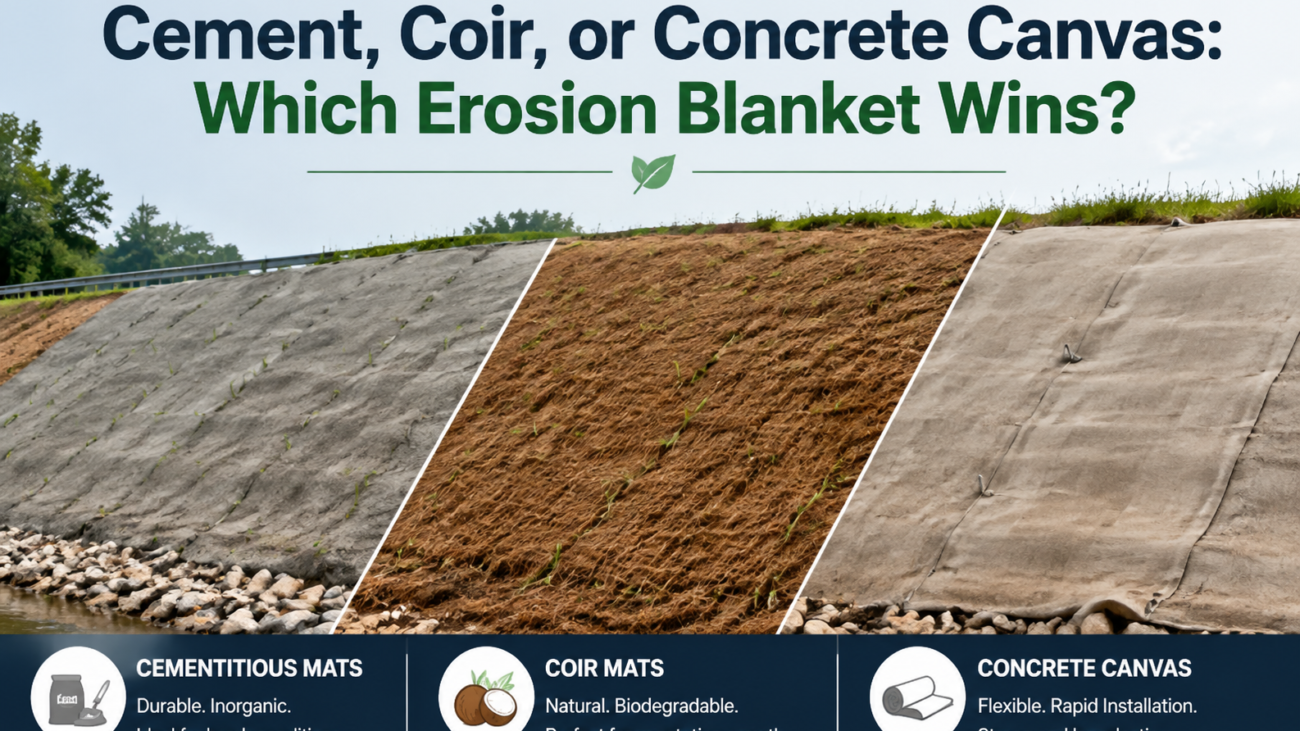
Cement, Coir, or Concrete Canvas: Which Erosion Blanket Wins? 

Cement, Coir, or Concrete Canvas: Which Erosion Blanket Wins? 

Search for an erosion control blanket, and the results won’t agree with each other. Some show a soft, natural-fibre mat that looks almost agricultural. Others show a grey, fabric-like roll that hardens into solid concrete once water hits it. A few use the phrase “concrete canvas” as though it were a different product from a “cement blanket,” when in most cases they’re describing the same material.

None of this is your fault for being confused. The terminology genuinely overlaps, and different suppliers, engineers, and regions default to different names for products that either do the same job or serve completely different purposes. Here’s what each term actually refers to, how the main categories differ in practice, and how to figure out which one, or which combination, fits your site.

What “Erosion Control Blanket” Actually Covers

Used broadly, “erosion control blanket” is an umbrella term for any rolled product laid across bare soil to protect it from rainfall impact and surface water flow. Under that umbrella sit products that behave completely differently once installed.

At one end are organic, biodegradable mats, coir being the most common in Indian projects, designed to hold soil temporarily while vegetation establishes, then break down and disappear. At the other end are cementitious mats, which look and install like a flexible fabric but chemically set into a rigid, permanent concrete layer once hydrated. That gives hard, long-term armouring instead of a temporary bridge to vegetation.

The confusion in search terms mostly comes down to people using “blanket” loosely across categories that need to be evaluated very differently once you get past the name.

Cement Blankets: Hard Armour That Sets Like Concrete

A cement blanket, more precisely a geosynthetic cementitious composite mat or GCCM, is a fabric impregnated with dry cementitious material, delivered to site as a flexible, rollable sheet. Ennkae’s nKrete GCCM is a four-dimensional fibre matrix made from a cement, sand, and admixture mix, fixed between two layers of polypropylene geotextile using needle-punch technology, with an HDPE geomembrane underneath acting as an additional waterproof layer.

Once positioned and hydrated, either by direct water application or rainfall, the cement within the fabric cures into a thin, continuous concrete layer that follows the contour of the ground. Ennkae’s material becomes hard, resilient concrete within 24 hours of hydration. The fibre reinforcement prevents cracking and absorbs impact energy, and the finished layer is chemical-resistant, fire-resistant, and abrasion-resistant.

The result behaves like poured concrete in terms of durability, but installs in a fraction of the time, without formwork, rebar cages, or curing infrastructure, and uses up to 95% less material than conventional concrete for many applications. That combination makes it the go-to choice for channels, spillways, drainage ditches, and slopes where water velocity is high enough that a biodegradable or vegetative solution would simply wash away. You can see the full detail on installation in our guide to GCCM installation, overlap, and curing targets.

Coir Blankets: Built to Disappear

At the opposite end of the spectrum, a coir blanket is a mat made from coconut fibre, designed to protect bare soil for a defined window while vegetation establishes and takes over the erosion-control job permanently. Ennkae’s nKoir range covers 400 to 900 GSM and is rated for a working lifespan of two to five years, depending on site conditions.

It doesn’t resist high-velocity flow the way a cement blanket does, and it isn’t meant to. It’s engineered for a different job, on slopes and banks where flow energy is moderate enough that a temporary, biodegradable cover is enough to get vegetation established. We’ve covered this material in more depth in our guide to coir geotextiles for erosion control, including how weight should be matched to slope and rainfall conditions.

Concrete Canvas: Is It Different From a Cement Blanket?

This is where most of the search confusion actually lives, so it’s worth addressing directly. Concrete canvas and cement blanket are, in almost every case, names for the same underlying product category, a GCCM. “Concrete canvas” tends to be the more descriptive, marketing-friendly term, emphasising that a flexible, canvas-like fabric turns into concrete once hydrated. “Cement blanket” is a more literal, functional description of the same thing. Some suppliers also use “fabric-formed concrete” or “cement sheet” for the same category.

If you’re comparing quotes described with any of these terms, evaluate them against the same criteria: thickness, cement content, reinforcement, tensile strength once cured, and installed cost per square metre. The name on the product sheet matters far less than the test data behind it. It’s worth asking a supplier directly what they mean by whichever term they’ve used in a quote, rather than assuming. Two quotes both labelled “erosion control blanket” could be describing a coir mat and a cementitious mat, products that differ enormously in cost, permanence, and suitability, simply because both suppliers reached for the same generic category name.

Matching the Blanket to the Site

The decision between hard-armour cementitious mat and biodegradable coir blanket, or a combination of both, comes down to three questions. Answering them honestly upfront avoids a far more expensive correction later.

How fast is the water moving, and how often? Low-velocity, intermittent flow on a moderately graded slope is well within what a properly specified coir blanket can handle while vegetation establishes. Sustained high-velocity flow, or a channel bed that sees flash flooding with real erosive force, calls for hard armouring instead.

Does the design need to be permanent from day one, or can it develop permanence over a season or two? A canal that needs to carry design flow within weeks doesn’t have time to wait for vegetation. A newly cut highway embankment often has exactly that time, and benefits from the lower cost and more natural finish of a vegetative solution.

Are there aesthetic, environmental, or regulatory requirements pushing toward a vegetated finish rather than exposed concrete? Many water-management and landscape projects are increasingly expected to maintain a green, natural-looking edge rather than visible hard armouring. That weighs the decision toward coir or a combination approach, even where a cement blanket would technically do the job.

Cost, Installation Speed, and Maintenance Over Time

Upfront material cost tends to dominate the conversation, but it’s rarely the number that matters most over the life of the installation. Coir blankets are almost always cheaper per square metre, and installation is fast: rolling and pinning a mat to a graded slope is quick, low-skill work. But that lower upfront number comes with a maintenance profile. Vegetation establishment needs monitoring, gaps may need reseeding, and if establishment fails in a section, that section is exposed again once the fibre breaks down.

A cement blanket costs more per square metre and typically takes longer to place and cure properly, but it’s largely a one-time cost. There’s no vegetation risk to monitor and no window of vulnerability while waiting for roots to develop. Over a project’s design life, particularly on high-consequence infrastructure like canal linings or rail embankments, the higher upfront cost often works out cheaper than the cumulative cost of maintaining a vegetative system in a difficult location.

Can You Combine Them?

In practice, a lot of well-designed erosion control doesn’t pick one system for an entire site. It assigns each material to the section where it performs best. A drainage channel might use a cement blanket across the base and lower side slopes, where flow velocity is highest, transitioning to coir matting on the upper banks, where flow energy drops off, and a vegetated finish is preferable. This layered approach is common on canal and highway drainage projects, and it’s usually more cost-effective than defaulting to hard armour across a slope when only part of it actually needs that level of protection.

Our broader comparison of erosion control solutions across GCCM, revetments, geocells, and coir systems walks through how these combinations are typically engineered on real sites, including where a GeoCell confinement system fits into the picture for steeper slope faces.

Conclusion

Whatever term brought you to this comparison- cement blanket, concrete canvas, erosion control blanket, or coir mat- the useful question isn’t which name sounds more modern or natural. It’s what your site’s flow conditions and permanence requirements actually demand. That’s what determines whether the installation is still doing its job in five years or needs to be redone.

If you’re not sure which category fits, send us your site details. Flow velocity, slope gradient, and whether the finish needs to be vegetated or can be exposed hard armour are usually enough to point toward the right system, or the right combination of systems.

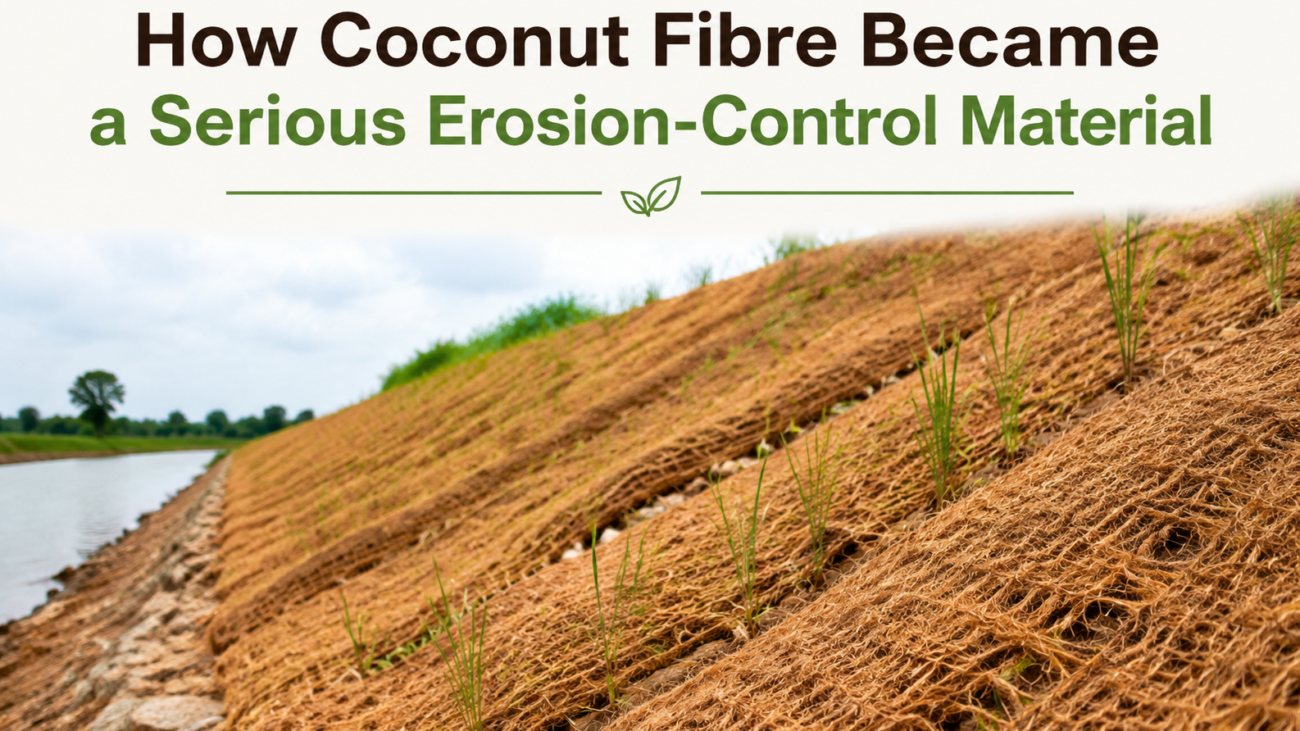
How Coconut Fibre Became a Serious Erosion-Control Material

How Coconut Fibre Became a Serious Erosion-Control Material

There’s something almost counterintuitive about using a material as ordinary as coconut fibre to protect a highway embankment or a riverbank from erosion. It sounds like a village craft technique, not civil engineering. But coir geotextile is one of the more quietly effective materials in slope protection. It has earned that reputation on thousands of kilometres of embankments, canal banks, and mining rehabilitation sites across India.

The idea behind it is simple. Hold the soil in place physically for long enough that vegetation can take over the job permanently. Everything else about coir geotextile- the weave density, where it’s used, where it isn’t enough on its own- follows from that one idea.

What Coir Geotextile Actually Is

Coir is the fibre extracted from a coconut husk. It has been used in rope, matting, and brushware for generations before anyone engineered it into a construction material. What makes it useful for erosion control is a mix of properties that’s genuinely hard to replicate synthetically. It’s strong enough to resist the impact of raindrops and surface water flow. It’s coarse enough to trap sediment and moisture against the soil surface. And it decomposes on a fairly predictable timeline.

Ennkae’s nKoir range is 100% biodegradable coconut fibre, available in weave densities from 400 GSM to 900 GSM, with a natural brown and green colour blend that sits well against a landscape rather than standing out from it. Lighter, more open weaves let more light and rain reach the soil beneath, which suits sites where fast vegetation growth is the priority. Denser weaves hold more soil and moisture directly against the surface, which suits steeper or more erosion-prone sections where a slower, sturdier establishment matters more than speed.

How It Stabilises a Slope Without Being Permanent

This is the part that surprises people used to thinking about erosion control in terms of concrete and steel. Coir geotextile isn’t designed to be the permanent solution. It’s designed to disappear.

When a mat is laid across a bare slope, it does two jobs immediately. It absorbs the direct impact energy of rainfall, often the single biggest driver of surface erosion on freshly graded soil. Bare earth under monsoon-intensity rain loses far more topsoil than the same slope with any kind of surface cover. The mat also slows surface runoff, giving water more time to soak in instead of carrying loose soil downhill with it.

At the same time, the mat traps seed, moisture, and organic matter against the soil surface, creating exactly the conditions vegetation needs to establish. Roots grow through the open structure and anchor into the soil beneath. Ennkae rates nKoir’s working lifespan at two to five years, depending on site conditions, which is usually enough time for a root system to develop and take over the erosion-control job permanently. The slope ends up stabilised by living vegetation rather than by an engineered product. That’s both cheaper to maintain long-term and, on many projects, the actual environmental requirement.

Where It’s Used

Highway and Railway Embankments

Freshly cut or filled embankments are at their most vulnerable in the months right after construction, before vegetation has had a chance to establish. Coir matting is a standard treatment here because it bridges that vulnerable window without adding a permanent structural element to a slope that’s often still settling.

Riverbank and Shoreline Protection

Lower-energy riverbanks, where flow velocity isn’t aggressive enough to demand hard armouring, are a natural fit for coir. It stabilises the bank while supporting bio-engineered restoration, the kind of vegetated, natural-looking edge that many water-management projects are increasingly expected to maintain.

Road, Rail, and Reclamation Work

Coir reinforces soft subgrades on road and railway embankments and minimises surface runoff damage during construction. It’s just as widely used on land reclamation and reforestation projects, where the core challenge is simply binding bare soil long enough for new growth to take hold. Mining and construction site rehabilitation rely on the same principle: aiding rapid revegetation right after a site has been disturbed.

Choosing the Right Weight for Your Slope

The single biggest mistake in coir specification isn’t choosing the wrong product category. It’s choosing the wrong weight for the site conditions. A mat selected for a gentle, well-drained slope in a moderate rainfall zone will likely underperform on a steep cut slope in a high-intensity monsoon catchment, even though both are technically coir geotextile.

Steeper gradients and higher rainfall intensity generally call for a heavier, denser weave, enough to resist being lifted or torn by concentrated runoff before vegetation establishes. Gentler slopes with reliable, evenly distributed rainfall can often work with a lighter, more open weave that gets vegetation established faster, since more light and moisture reach the soil directly. Getting this match right depends on the specific site: soil type, rainfall pattern, slope angle, expected vegetation. It’s worth discussing actual site conditions before ordering rather than defaulting to whatever weight was used on the last project.

Where Coir Alone Isn’t Enough

Coir geotextile does one job extremely well: bridging the gap until vegetation establishes on low-to-moderate energy slopes. It isn’t the right tool for every erosion problem, and being honest about that boundary is part of specifying it correctly.

On steep channel beds, spillways, or anywhere flow velocity is genuinely high, a biodegradable mat won’t survive long enough to matter. The erosive force is greater than the fibre can resist, regardless of weave density. These conditions call for a hard-armour solution instead, which is where GCCM or concrete revetment systems take over. Our comparison of erosion control blanket options walks through exactly how to decide between a biodegradable mat and a cementitious one based on flow conditions and how permanent the design needs to be.

It’s also common, and often the smarter design, to combine systems: coir on the gentler side slopes of a channel, with a cementitious mat armouring the base where flow energy concentrates. Our broader look at erosion control solutions covers how these systems are typically layered together on real projects.

Installing It So It Actually Performs

A coir mat that isn’t in firm contact with the soil beneath it can’t do its job, no matter how well the weight was specified. Ennkae’s recommended process starts with clearing the site of large debris, then unrolling the geotextile with a slight overlap between strips. Anchoring comes next, using wooden pegs or metal staples at regular intervals, with extra anchoring at the crest of the slope and along the edges. That keeps the mat from lifting under wind or the first significant runoff event, before roots grow through it and take over the anchoring job themselves.

Seeding matters too. Spreading seed over and under the mat during installation, rather than relying on windblown seed afterward, shortens the vulnerable window considerably. Watering and regular monitoring in the weeks after installation round out the process and catch any bare patches early, while they’re still easy to fix.

The Sustainability Case

There’s a practical sustainability argument for coir beyond it simply being biodegradable. It’s fully biodegradable, made from a renewable material, and leaves no synthetic fibre behind once its job is done. For projects working toward green building certifications or environmental clearance conditions that call for natural, low-impact materials, that combination is hard to match with a synthetic alternative. It also, in most cases, improves soil quality over the life of the installation rather than remaining a neutral or inert layer the way many synthetic geotextiles do.

Conclusion

Coir geotextile rewards getting the basics right: the correct weight for the slope, an honest read on whether flow conditions are within its range, and installation that keeps the mat in firm contact with the soil rather than bridging gaps where erosion can start underneath it. Done well, it’s one of the more cost-effective and genuinely sustainable tools available for stabilising a slope while nature finishes the job.

If you’re working out whether a site calls for coir, a hard-armour solution, or a combination of both, reach out to our team with your slope details. Flow conditions, gradient, and rainfall pattern are usually enough to point toward the right system.

What Non-Woven Fabric Does in Construction 

The Hidden Workhorse: What Non-Woven Fabric Does in Construction 

Walk any major road, rail, or drainage project in India today, and there’s a good chance a thin, felt-like fabric is doing more structural work underground than most people realise. It doesn’t show up in the finished photographs. Once the aggregate goes on top of it, it disappears from view for the rest of the structure’s life. Pull that layer out, though, and a surprising number of well-engineered roads and embankments would start failing within a couple of monsoon seasons.

That fabric is non-woven geotextile. It’s one of those materials that does its job precisely because nobody has to think about it afterward. Here’s what it actually does, where it earns its place, and what to check before you order a roll of it.

What “Non-Woven” Actually Means

The name describes how the fabric is made, and that process is what gives it its properties. A woven geotextile is made on a loom, with fibres running in two fixed directions. A non-woven fabric is different. Continuous polypropylene or polyester filaments are laid down in a random, overlapping pattern, then mechanically bonded through needle-punching. Thousands of barbed needles interlock the fibres into a dense, felt-like mat.

That random fibre orientation is the whole point. A woven fabric gives excellent tensile strength along its two fixed axes, but water can only move along fixed paths. A needle-punched non-woven fabric has openings running in every direction through its thickness. That’s exactly what you want when the job is to let water pass through while holding soil particles back.

Weight is usually described in GSM, grams per square metre. Ennkae’s non-woven range runs from 90 GSM to 500 GSM, in widths up to five metres, made from polypropylene or polyester. It’s the first number worth asking about on any quote. It tells you far more about how the fabric will perform than price alone.

The Three Jobs This One Fabric Does

Most construction materials do one thing. Non-woven geotextile routinely does three, sometimes on the same project.

Separation

Roads, railway tracks, and building foundations are built in layers: a soft subgrade at the bottom, then progressively coarser aggregate on top. Left alone, those layers mix under traffic load and moisture cycling. Fine subgrade soil migrates up into the aggregate and destroys its load-bearing capacity within a few years. A non-woven layer placed between subgrade and aggregate keeps the two apart, so the aggregate layer keeps doing the job it was designed for.

Filtration

Water needs to move through soil and drainage systems without dragging fine particles along with it. That’s what causes drains to clog and silt to build up where it shouldn’t. Non-woven fabric filters at that boundary. Water passes through the felted fibre structure. Soil particles above a certain size stay on the surface instead of migrating into the drainage layer and choking it over time.

Drainage

The fabric itself has measurable in-plane permeability. That means it can move water laterally within its own thickness, not just let it pass straight through. This makes it a natural companion to perforated drainage pipes. Wrapped around a pipe, it keeps soil out of the slots while still letting groundwater reach it freely.

Where It Shows Up On a Job Site

Because it performs all three functions, non-woven geotextile ends up in a wide range of work that doesn’t otherwise have much in common. Ennkae’s own applications list covers road construction, drainage systems, landfills and embankments, retaining walls, and erosion control on slopes.

Highway and railway projects use it as a separation layer beneath ballast and sub-ballast, protecting the load-bearing aggregate from subgrade contamination. That use case has only grown as India’s rail and road expansion pushes into softer, less predictable soils. Retaining walls and French drains rely on it to keep backfill soil from clogging the drainage path behind the wall face. That’s often the difference between a wall that sheds water safely and one that builds up pressure it was never designed to handle.

It’s also frequently placed directly beneath an HDPE geomembrane or GCL installation to protect the impermeable layer above it from sharp stones in the subgrade below. If you’re specifying a geomembrane liner for a pond, canal, or reservoir, this cushioning role is one of the most overlooked line items in the design. Skip it, and the liner above inherits every sharp edge in the ground beneath it.

It also turns up in erosion and embankment work, often layered underneath the cementitious mats and rail ballast systems covered in our guide to choosing the right mat for rail, drain, and embankment works. On slope stabilisation projects that combine several systems, a GeoCell confinement layer over a soft embankment is a good example, a non-woven layer is often the unglamorous first step that goes down before any of the more visible reinforcement work begins.

Non-Woven vs Woven, Not Interchangeable

Non-woven and woven geotextiles aren’t two grades of the same product. They’re suited to different jobs, and substituting one for the other usually shows up as a problem later rather than immediately.

Woven geotextile is built for reinforcement. Its fibres run in fixed directions, giving it high tensile strength along those axes. That makes it the better choice where the fabric needs to resist stretching under load, reinforcing a soft subgrade beneath an embankment, for example. Non-woven fabric trades some of that directional strength for multi-directional permeability and a thicker, more cushioning profile. That’s exactly what separation, filtration, and protection applications need instead.

Some projects genuinely need both, layered for different purposes. Very few projects are well served by treating the two as interchangeable just because they’re both technically geotextiles.

Specs Worth Checking Before You Order

A handful of numbers tell you whether a non-woven fabric will actually perform on your site. GSM is the starting point. Heavier fabric generally means better puncture resistance and a longer service life under load. The right number depends on subgrade strength, often expressed as a CBR value for road projects, and on what sits on top of it.

Permittivity tells you how easily water passes through the fabric vertically, which matters most for filtration. Apparent opening size describes the fabric’s effective pore size and needs to be matched against the soil gradation it’s meant to filter. Too coarse, and fine soil washes through. Too fine, and the fabric clogs early. Tensile strength and puncture resistance round out the picture, particularly for separation layers under heavy construction traffic.

For road and rail projects, it’s worth checking the fabric against relevant IRC and MoRTH specifications rather than a generic international standard. Indian subgrade conditions and construction practices don’t always map cleanly onto specs written for other markets. It’s also worth asking a supplier for batch-level test certificates rather than accepting a generic product data sheet. A certificate tied to the actual roll being delivered tells you what you’re getting on your project, not just what the catalogue promises.

Installation Details That Determine Whether It Actually Works

Even the correct fabric, properly specified, can underperform if it’s installed carelessly. Because the fabric disappears under aggregate almost immediately, installation mistakes are rarely caught until the layer above it starts failing.

Overlap between rolls matters more than it might seem. A gap, or an insufficiently overlapped seam, gives fine soil a direct path around the fabric instead of through it. That quietly defeats the separation function at exactly the point where two rolls meet. Most specifications call for a minimum overlap, commonly in the 300 to 450 mm range depending on subgrade conditions. It’s worth confirming the crew is actually holding to that figure rather than treating it as a rough guideline.

Tension and wrinkling are the other common problems. Fabric laid too loosely can bunch and fold under the weight of aggregate placed on top of it, creating pockets where soil can bypass the filtration layer entirely. Laid too tight, it can tear during compaction. A good crew unrolls the fabric with enough slack to accommodate settlement, without leaving loose folds, and avoids driving equipment over an unprotected section before a working layer of aggregate is in place.

Conclusion

Non-woven geotextile is inexpensive relative to almost everything it protects: the aggregate above it, the drainage system around it, the geomembrane or GCL sitting on top of it. That’s exactly why it’s worth specifying properly instead of sourcing it on price alone. The wrong GSM or a mismatched opening size doesn’t fail immediately. It fails slowly, in ways that are much harder to diagnose once everything else is already built on top of it.

If you’re working through the separation, filtration, or drainage layer for an upcoming project, talk to our team about matching the non-woven geotextile spec to your subgrade and load conditions before the design is finalised.