
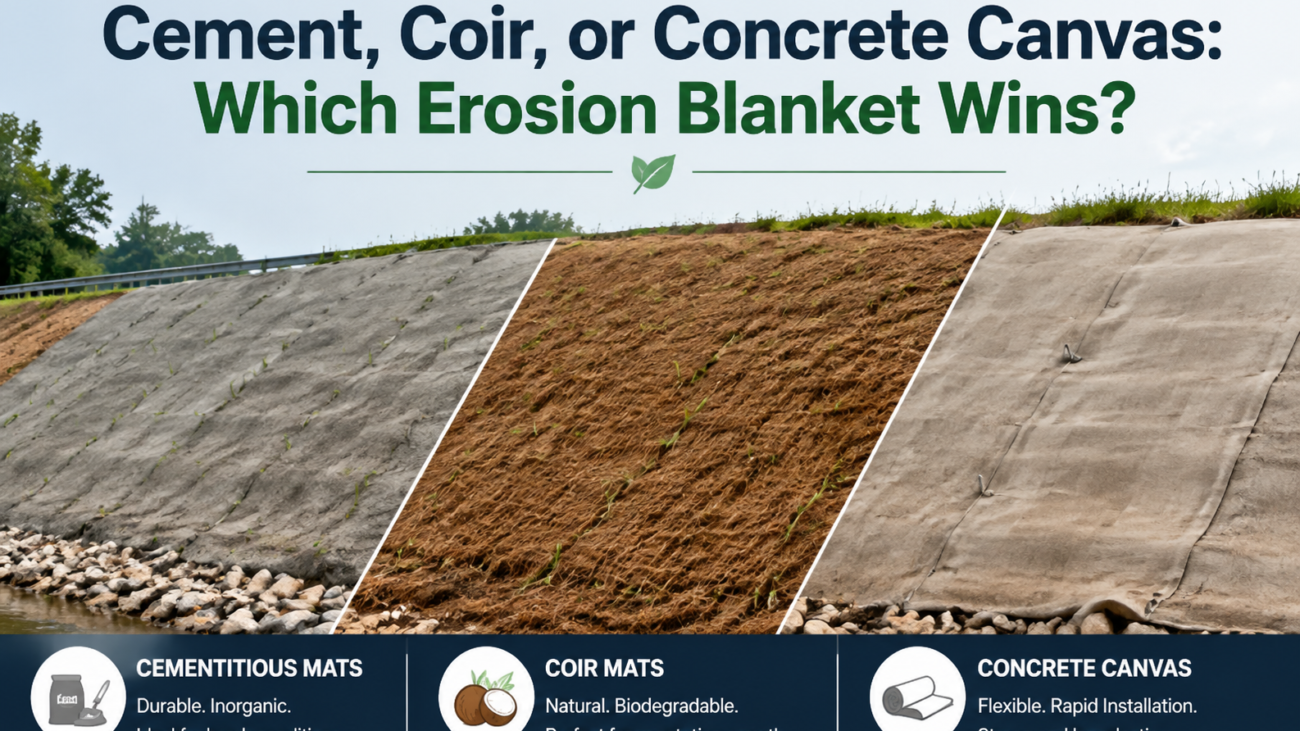
Search for an erosion control blanket, and the results won’t agree with each other. Some show a soft, natural-fibre mat that looks almost agricultural. Others show a grey, fabric-like roll that hardens into solid concrete once water hits it. A few use the phrase “concrete canvas” as though it were a different product from a “cement blanket,” when in most cases they’re describing the same material.
None of this is your fault for being confused. The terminology genuinely overlaps, and different suppliers, engineers, and regions default to different names for products that either do the same job or serve completely different purposes. Here’s what each term actually refers to, how the main categories differ in practice, and how to figure out which one, or which combination, fits your site.
What “Erosion Control Blanket” Actually Covers
Used broadly, “erosion control blanket” is an umbrella term for any rolled product laid across bare soil to protect it from rainfall impact and surface water flow. Under that umbrella sit products that behave completely differently once installed.
At one end are organic, biodegradable mats, coir being the most common in Indian projects, designed to hold soil temporarily while vegetation establishes, then break down and disappear. At the other end are cementitious mats, which look and install like a flexible fabric but chemically set into a rigid, permanent concrete layer once hydrated. That gives hard, long-term armouring instead of a temporary bridge to vegetation.
The confusion in search terms mostly comes down to people using “blanket” loosely across categories that need to be evaluated very differently once you get past the name.
Cement Blankets: Hard Armour That Sets Like Concrete
A cement blanket, more precisely a geosynthetic cementitious composite mat or GCCM, is a fabric impregnated with dry cementitious material, delivered to site as a flexible, rollable sheet. Ennkae’s nKrete GCCM is a four-dimensional fibre matrix made from a cement, sand, and admixture mix, fixed between two layers of polypropylene geotextile using needle-punch technology, with an HDPE geomembrane underneath acting as an additional waterproof layer.
Once positioned and hydrated, either by direct water application or rainfall, the cement within the fabric cures into a thin, continuous concrete layer that follows the contour of the ground. Ennkae’s material becomes hard, resilient concrete within 24 hours of hydration. The fibre reinforcement prevents cracking and absorbs impact energy, and the finished layer is chemical-resistant, fire-resistant, and abrasion-resistant.
The result behaves like poured concrete in terms of durability, but installs in a fraction of the time, without formwork, rebar cages, or curing infrastructure, and uses up to 95% less material than conventional concrete for many applications. That combination makes it the go-to choice for channels, spillways, drainage ditches, and slopes where water velocity is high enough that a biodegradable or vegetative solution would simply wash away. You can see the full detail on installation in our guide to GCCM installation, overlap, and curing targets.
Coir Blankets: Built to Disappear
At the opposite end of the spectrum, a coir blanket is a mat made from coconut fibre, designed to protect bare soil for a defined window while vegetation establishes and takes over the erosion-control job permanently. Ennkae’s nKoir range covers 400 to 900 GSM and is rated for a working lifespan of two to five years, depending on site conditions.
It doesn’t resist high-velocity flow the way a cement blanket does, and it isn’t meant to. It’s engineered for a different job, on slopes and banks where flow energy is moderate enough that a temporary, biodegradable cover is enough to get vegetation established. We’ve covered this material in more depth in our guide to coir geotextiles for erosion control, including how weight should be matched to slope and rainfall conditions.
Concrete Canvas: Is It Different From a Cement Blanket?
This is where most of the search confusion actually lives, so it’s worth addressing directly. Concrete canvas and cement blanket are, in almost every case, names for the same underlying product category, a GCCM. “Concrete canvas” tends to be the more descriptive, marketing-friendly term, emphasising that a flexible, canvas-like fabric turns into concrete once hydrated. “Cement blanket” is a more literal, functional description of the same thing. Some suppliers also use “fabric-formed concrete” or “cement sheet” for the same category.
If you’re comparing quotes described with any of these terms, evaluate them against the same criteria: thickness, cement content, reinforcement, tensile strength once cured, and installed cost per square metre. The name on the product sheet matters far less than the test data behind it. It’s worth asking a supplier directly what they mean by whichever term they’ve used in a quote, rather than assuming. Two quotes both labelled “erosion control blanket” could be describing a coir mat and a cementitious mat, products that differ enormously in cost, permanence, and suitability, simply because both suppliers reached for the same generic category name.
Matching the Blanket to the Site
The decision between hard-armour cementitious mat and biodegradable coir blanket, or a combination of both, comes down to three questions. Answering them honestly upfront avoids a far more expensive correction later.
How fast is the water moving, and how often? Low-velocity, intermittent flow on a moderately graded slope is well within what a properly specified coir blanket can handle while vegetation establishes. Sustained high-velocity flow, or a channel bed that sees flash flooding with real erosive force, calls for hard armouring instead.
Does the design need to be permanent from day one, or can it develop permanence over a season or two? A canal that needs to carry design flow within weeks doesn’t have time to wait for vegetation. A newly cut highway embankment often has exactly that time, and benefits from the lower cost and more natural finish of a vegetative solution.
Are there aesthetic, environmental, or regulatory requirements pushing toward a vegetated finish rather than exposed concrete? Many water-management and landscape projects are increasingly expected to maintain a green, natural-looking edge rather than visible hard armouring. That weighs the decision toward coir or a combination approach, even where a cement blanket would technically do the job.
Cost, Installation Speed, and Maintenance Over Time
Upfront material cost tends to dominate the conversation, but it’s rarely the number that matters most over the life of the installation. Coir blankets are almost always cheaper per square metre, and installation is fast: rolling and pinning a mat to a graded slope is quick, low-skill work. But that lower upfront number comes with a maintenance profile. Vegetation establishment needs monitoring, gaps may need reseeding, and if establishment fails in a section, that section is exposed again once the fibre breaks down.
A cement blanket costs more per square metre and typically takes longer to place and cure properly, but it’s largely a one-time cost. There’s no vegetation risk to monitor and no window of vulnerability while waiting for roots to develop. Over a project’s design life, particularly on high-consequence infrastructure like canal linings or rail embankments, the higher upfront cost often works out cheaper than the cumulative cost of maintaining a vegetative system in a difficult location.
Can You Combine Them?
In practice, a lot of well-designed erosion control doesn’t pick one system for an entire site. It assigns each material to the section where it performs best. A drainage channel might use a cement blanket across the base and lower side slopes, where flow velocity is highest, transitioning to coir matting on the upper banks, where flow energy drops off, and a vegetated finish is preferable. This layered approach is common on canal and highway drainage projects, and it’s usually more cost-effective than defaulting to hard armour across a slope when only part of it actually needs that level of protection.
Our broader comparison of erosion control solutions across GCCM, revetments, geocells, and coir systems walks through how these combinations are typically engineered on real sites, including where a GeoCell confinement system fits into the picture for steeper slope faces.
Conclusion
Whatever term brought you to this comparison- cement blanket, concrete canvas, erosion control blanket, or coir mat- the useful question isn’t which name sounds more modern or natural. It’s what your site’s flow conditions and permanence requirements actually demand. That’s what determines whether the installation is still doing its job in five years or needs to be redone.
If you’re not sure which category fits, send us your site details. Flow velocity, slope gradient, and whether the finish needs to be vegetated or can be exposed hard armour are usually enough to point toward the right system, or the right combination of systems.