
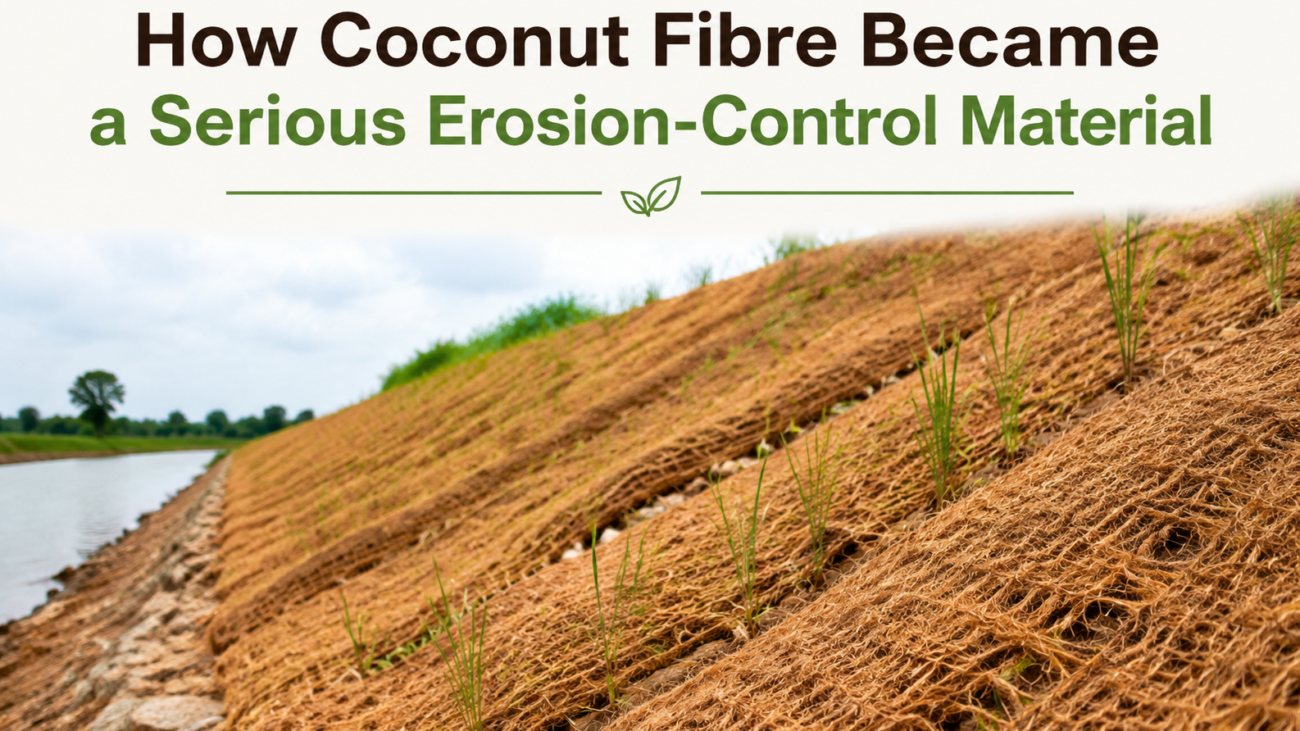
There’s something almost counterintuitive about using a material as ordinary as coconut fibre to protect a highway embankment or a riverbank from erosion. It sounds like a village craft technique, not civil engineering. But coir geotextile is one of the more quietly effective materials in slope protection. It has earned that reputation on thousands of kilometres of embankments, canal banks, and mining rehabilitation sites across India.
The idea behind it is simple. Hold the soil in place physically for long enough that vegetation can take over the job permanently. Everything else about coir geotextile- the weave density, where it’s used, where it isn’t enough on its own- follows from that one idea.
What Coir Geotextile Actually Is
Coir is the fibre extracted from a coconut husk. It has been used in rope, matting, and brushware for generations before anyone engineered it into a construction material. What makes it useful for erosion control is a mix of properties that’s genuinely hard to replicate synthetically. It’s strong enough to resist the impact of raindrops and surface water flow. It’s coarse enough to trap sediment and moisture against the soil surface. And it decomposes on a fairly predictable timeline.
Ennkae’s nKoir range is 100% biodegradable coconut fibre, available in weave densities from 400 GSM to 900 GSM, with a natural brown and green colour blend that sits well against a landscape rather than standing out from it. Lighter, more open weaves let more light and rain reach the soil beneath, which suits sites where fast vegetation growth is the priority. Denser weaves hold more soil and moisture directly against the surface, which suits steeper or more erosion-prone sections where a slower, sturdier establishment matters more than speed.
How It Stabilises a Slope Without Being Permanent
This is the part that surprises people used to thinking about erosion control in terms of concrete and steel. Coir geotextile isn’t designed to be the permanent solution. It’s designed to disappear.
When a mat is laid across a bare slope, it does two jobs immediately. It absorbs the direct impact energy of rainfall, often the single biggest driver of surface erosion on freshly graded soil. Bare earth under monsoon-intensity rain loses far more topsoil than the same slope with any kind of surface cover. The mat also slows surface runoff, giving water more time to soak in instead of carrying loose soil downhill with it.
At the same time, the mat traps seed, moisture, and organic matter against the soil surface, creating exactly the conditions vegetation needs to establish. Roots grow through the open structure and anchor into the soil beneath. Ennkae rates nKoir’s working lifespan at two to five years, depending on site conditions, which is usually enough time for a root system to develop and take over the erosion-control job permanently. The slope ends up stabilised by living vegetation rather than by an engineered product. That’s both cheaper to maintain long-term and, on many projects, the actual environmental requirement.
Where It’s Used
Highway and Railway Embankments
Freshly cut or filled embankments are at their most vulnerable in the months right after construction, before vegetation has had a chance to establish. Coir matting is a standard treatment here because it bridges that vulnerable window without adding a permanent structural element to a slope that’s often still settling.
Riverbank and Shoreline Protection
Lower-energy riverbanks, where flow velocity isn’t aggressive enough to demand hard armouring, are a natural fit for coir. It stabilises the bank while supporting bio-engineered restoration, the kind of vegetated, natural-looking edge that many water-management projects are increasingly expected to maintain.
Road, Rail, and Reclamation Work
Coir reinforces soft subgrades on road and railway embankments and minimises surface runoff damage during construction. It’s just as widely used on land reclamation and reforestation projects, where the core challenge is simply binding bare soil long enough for new growth to take hold. Mining and construction site rehabilitation rely on the same principle: aiding rapid revegetation right after a site has been disturbed.
Choosing the Right Weight for Your Slope
The single biggest mistake in coir specification isn’t choosing the wrong product category. It’s choosing the wrong weight for the site conditions. A mat selected for a gentle, well-drained slope in a moderate rainfall zone will likely underperform on a steep cut slope in a high-intensity monsoon catchment, even though both are technically coir geotextile.
Steeper gradients and higher rainfall intensity generally call for a heavier, denser weave, enough to resist being lifted or torn by concentrated runoff before vegetation establishes. Gentler slopes with reliable, evenly distributed rainfall can often work with a lighter, more open weave that gets vegetation established faster, since more light and moisture reach the soil directly. Getting this match right depends on the specific site: soil type, rainfall pattern, slope angle, expected vegetation. It’s worth discussing actual site conditions before ordering rather than defaulting to whatever weight was used on the last project.
Where Coir Alone Isn’t Enough
Coir geotextile does one job extremely well: bridging the gap until vegetation establishes on low-to-moderate energy slopes. It isn’t the right tool for every erosion problem, and being honest about that boundary is part of specifying it correctly.
On steep channel beds, spillways, or anywhere flow velocity is genuinely high, a biodegradable mat won’t survive long enough to matter. The erosive force is greater than the fibre can resist, regardless of weave density. These conditions call for a hard-armour solution instead, which is where GCCM or concrete revetment systems take over. Our comparison of erosion control blanket options walks through exactly how to decide between a biodegradable mat and a cementitious one based on flow conditions and how permanent the design needs to be.
It’s also common, and often the smarter design, to combine systems: coir on the gentler side slopes of a channel, with a cementitious mat armouring the base where flow energy concentrates. Our broader look at erosion control solutions covers how these systems are typically layered together on real projects.
Installing It So It Actually Performs
A coir mat that isn’t in firm contact with the soil beneath it can’t do its job, no matter how well the weight was specified. Ennkae’s recommended process starts with clearing the site of large debris, then unrolling the geotextile with a slight overlap between strips. Anchoring comes next, using wooden pegs or metal staples at regular intervals, with extra anchoring at the crest of the slope and along the edges. That keeps the mat from lifting under wind or the first significant runoff event, before roots grow through it and take over the anchoring job themselves.
Seeding matters too. Spreading seed over and under the mat during installation, rather than relying on windblown seed afterward, shortens the vulnerable window considerably. Watering and regular monitoring in the weeks after installation round out the process and catch any bare patches early, while they’re still easy to fix.
The Sustainability Case
There’s a practical sustainability argument for coir beyond it simply being biodegradable. It’s fully biodegradable, made from a renewable material, and leaves no synthetic fibre behind once its job is done. For projects working toward green building certifications or environmental clearance conditions that call for natural, low-impact materials, that combination is hard to match with a synthetic alternative. It also, in most cases, improves soil quality over the life of the installation rather than remaining a neutral or inert layer the way many synthetic geotextiles do.
Conclusion
Coir geotextile rewards getting the basics right: the correct weight for the slope, an honest read on whether flow conditions are within its range, and installation that keeps the mat in firm contact with the soil rather than bridging gaps where erosion can start underneath it. Done well, it’s one of the more cost-effective and genuinely sustainable tools available for stabilising a slope while nature finishes the job.
If you’re working out whether a site calls for coir, a hard-armour solution, or a combination of both, reach out to our team with your slope details. Flow conditions, gradient, and rainfall pattern are usually enough to point toward the right system.