
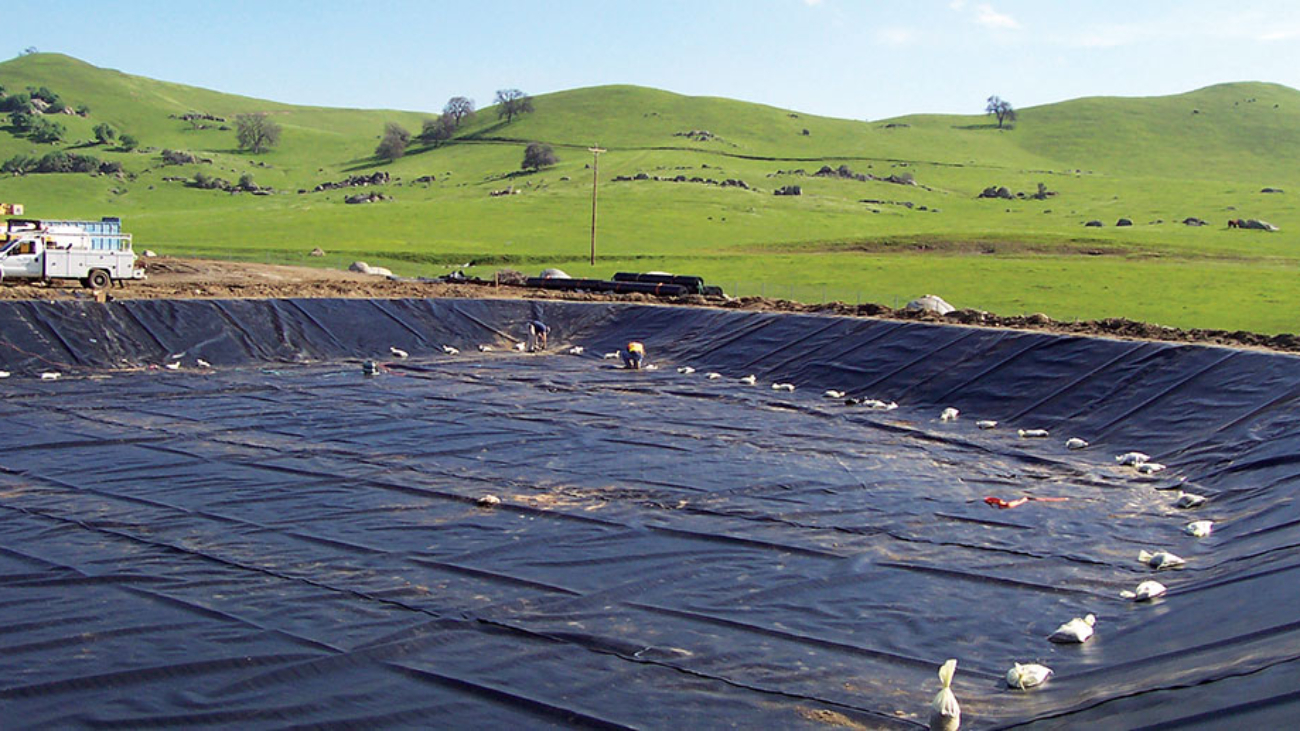
Water rarely announces when it is leaving. A farm pond loses a few centimetres a week. An irrigation canal reaches the field half empty. A rooftop tank leaves a damp patch on the ceiling below it. By the time anyone notices, the loss has already cost real money.
In almost every case, the fix comes down to one decision made early in the project: the liner. Geomembranes have become the default answer across Indian infrastructure, agriculture, and even home waterproofing. Nobody visits a reservoir to admire the liner underneath it. But get the selection wrong, and everything built on top of it starts failing within a season or two. Get it right, and it works quietly for decades.
Here is what a geomembrane liner actually does, where it earns its place, and the decisions that separate a liner that lasts from one that needs replacing far too soon.
What Makes HDPE Different From Other Lining Materials
A geomembrane is a manufactured polymer sheet built to be effectively impermeable. High-density polyethylene is the material of choice for most containment and lining work in India today. It combines chemical resistance, UV stability, and mechanical strength at a cost that is hard to beat.
Compare that to the alternatives. A compacted clay liner needs thick sections of carefully controlled soil and weeks of compaction work. It stays vulnerable to cracking if it ever dries out. A geosynthetic clay liner closes some of that gap using bentonite clay, and it is usually chosen for its self-healing properties rather than raw hydrostatic performance. HDPE takes a different approach. It is manufactured to a consistent thickness, arrives ready to weld, and once seamed correctly, behaves as one continuous barrier across an entire pond or canal bed.
Ennkae’s HDPE geomembranes are made from virgin high-density polyethylene resin and supplied in thicknesses from 0.3 mm to 3.0 mm, in smooth or textured finishes, so the gauge can be matched to the application rather than forced into a one-size-fits-all sheet. The material is UV-stabilised for exposed installations and manufactured to meet international standards including GSI, ASTM, and ISO.
Where Geomembrane Liners Actually Get Used
The range of projects that quietly depend on a geomembrane is wider than most people expect.
Agriculture and water storage. Farm ponds and rainwater harvesting systems lose a surprising volume of water to seepage in porous soils. A lined pond holds its capacity through an entire dry season. Fish and shrimp farming depends on liners to maintain water quality and depth without constantly topping up, and irrigation canals lined with HDPE deliver far more water to the field than an unlined earthen channel.
Landfills and industrial containment. Landfill liners and caps stop leachate from migrating into the surrounding ground. Mining and heap leach pads use geomembranes to contain the chemicals used in ore processing. Industrial and hazardous waste facilities rely on the same barrier principle to keep effluent and by-products where they belong. Secondary containment around fuel and chemical storage tanks adds one more layer of protection in case the primary tank ever fails.
Waterproofing closer to home. The same material shows up under terrace gardens, inside overhead tanks, and across basement slabs, where waterproofing has to survive years of hydrostatic pressure without a single weak point. It is the same core decision as a canal lining project, just at a smaller scale.
What ties these applications together is simple. Somewhere in the design, an engineer decided that water or fluid needed to stay on one side of a boundary. A geomembrane is the most reliable way to enforce that boundary for the life of the structure.
Choosing the Right Thickness and Grade
Thickness is not a one-size-fits-all number. A shallow farm pond with light traffic does not need the same gauge as a deep effluent lagoon holding aggressive chemicals, or a canal bed exposed to abrasion from moving silt.
Lighter applications like farm ponds and harvesting pits can often work with a thinner gauge. Deep reservoirs, lagoons, and canal linings exposed to traffic or debris call for a heavier sheet. It is a false economy to size the liner purely on today’s budget. The cost difference between gauges is small next to the cost of draining, patching, and refilling a pond a few years later.
What sits underneath the liner matters just as much as the sheet itself. A geomembrane laid directly over rocky or uneven ground is a puncture waiting to happen, no matter how thick it is. This is why most well-engineered lining systems place a non-woven geotextile cushion layer beneath the geomembrane. It absorbs the sharp points in the subgrade that would otherwise work their way through the liner under load.
Seam quality matters as much as sheet thickness. HDPE panels are joined on site using hot wedge or extrusion welding. A liner is only as strong as its weakest seam, and a poorly welded joint fails exactly where that joint sits, usually without warning.
Quality Checks Before You Sign Off on a Liner
A handful of checks separate an installation you can trust from one you are hoping works out. Ask for thickness verification across the roll, not just the manufacturer’s stated spec. Confirm the finish, smooth or textured, matches what your slope and friction requirements call for.
Seam integrity should be tested on site. Ennkae’s standard installation process includes air pressure and vacuum testing on every seam, which catches pinholes and weak joints before the liner is ever put into service. Ask for tensile strength and puncture resistance certificates too. They tell you how the material will behave under stress rather than just how it looks on a data sheet.
None of this is exotic. It is standard practice on any project where the liner is expected to last. The projects that run into trouble are almost always the ones where a check was skipped to save a few days on the schedule.
Common Mistakes That Cut a Liner’s Life Short
Most geomembrane failures do not happen because the material was wrong. They happen because of a handful of avoidable decisions during installation.
The anchor trench is the first place things go wrong. A liner that is not secured properly at the edges will creep under thermal expansion, especially where day-to-night temperatures swing widely. That movement stresses the seams over time. Skipping or under-sizing the anchor trench to save a day of excavation is a common shortcut, and an expensive one to fix once the pond is already full.
Site traffic during installation is another quiet culprit. Sharp tools, loose stones on boots, or equipment driven over an unprotected liner can leave punctures too small to notice at handover but large enough to leak for years. A good crew treats the liner as live infrastructure the moment it is unrolled.
Slope stability is worth checking separately from the liner itself. A geomembrane can only do its job if the earthworks beneath it stay put. If a slope is not properly compacted, ground movement can shift or tear a liner that was installed perfectly. This is often where a geomembrane project overlaps with broader slope protection work, and it is worth having both addressed by the same team.
Why the Manufacturer You Choose Matters
Two rolls of HDPE geomembrane can look identical on a spec sheet and still perform very differently on site. Consistency between rolls, support during welding, and a manufacturer who understands local site conditions all shape how the liner performs once it is buried under water or backfilled with soil.
This is where working with an established HDPE geomembrane manufacturer pays off. Not just in the roll of material, but in installation support, welding quality assurance, and the ability to troubleshoot a difficult subgrade before it becomes an expensive problem. For larger or more sensitive containment projects, geomembranes are increasingly paired with a geosynthetic clay liner as a composite system. The GCL’s self-healing bentonite core backs up the geomembrane’s raw impermeability in case either layer is ever compromised. Our guide on budgeting for clay liners breaks down what drives GCL pricing, so you can compare the full picture rather than the geomembrane cost alone.
Conclusion
A geomembrane liner gets almost no attention when it is done right, and all of the attention when it isn’t. Whether you are lining a farm pond, a municipal reservoir, or waterproofing a terrace, the same principles apply. Pick the right thickness for the load and exposure. Protect the sheet from what’s underneath it. Insist on tested seams. Choose a manufacturer who stands behind the installation, not just the roll of material.
If you are planning a water storage or waterproofing project and want a thickness and grade recommendation for your site, talk to our team. It’s a far cheaper conversation to have before the liner goes into the ground than after.